CALL US

804.589.0503

EMAIL US

info@redfernhemp.com

HOURS

Mon.-Sat. • 11am-7pm

CHP 8 | Early Garden Hemp Hero

The early household lived in close contact with nature. The Secrets of Alexis of Piemont treats the home and garden as sites of experimentation, where agriculture, domestic management, and natural philosophy were in constant negotiation. Knowledge was passed down not only through books, but often through oral tradition, inherited like any other household tool. Hemp, valued for its reliability, became a practical instrument in every homestead. What worked mattered more than why it worked. The practice of preserving a rose’s vivid red beauty through the winter months is a perfect example of that kind of lived, pragmatic “magic.”


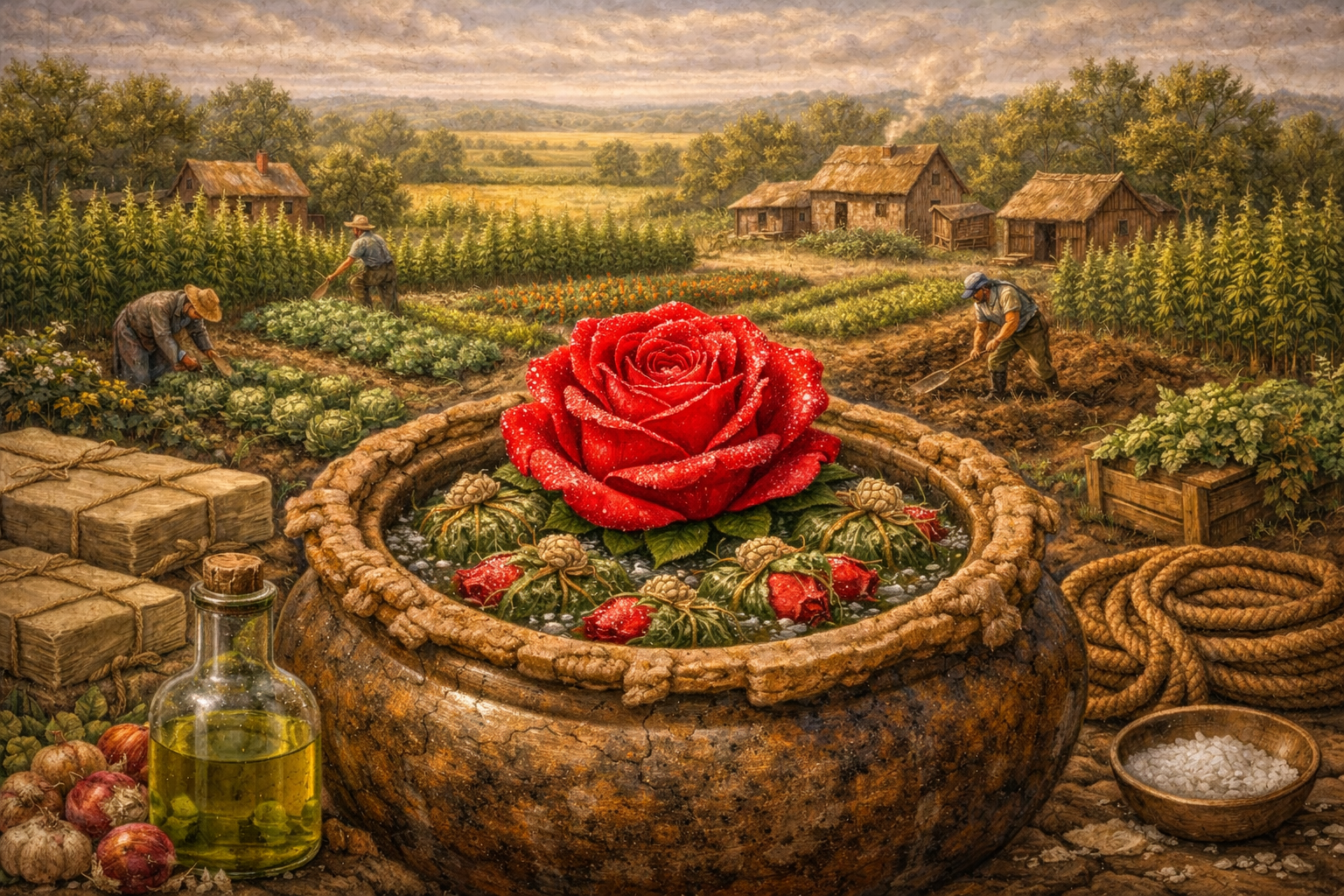
Gather the roses before they open, when they are just ready to break. They must be red Provence roses. Leave the stalks long enough, and wrap them in vine leaves or in hemp, in small parcels, placing twelve roses in each. Powder them with white salt and place them in an earthen pot, salting them as you would purslane. Then fill the pot with verjuice, a highly acidic juice, and seal it by laying clay around the lid so that no air may enter.
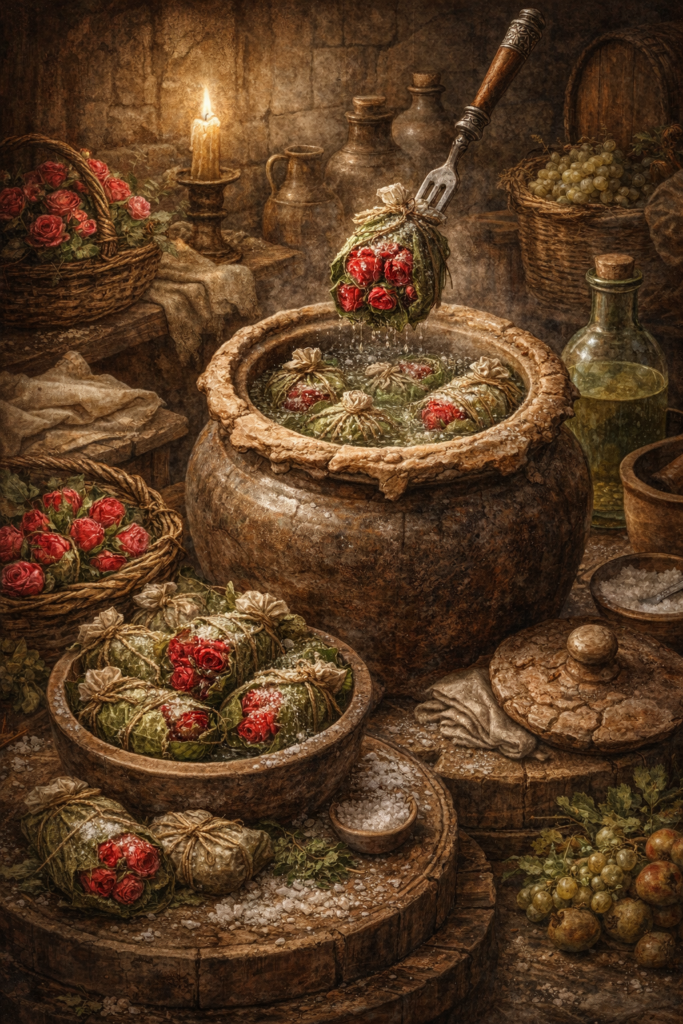
At Christmas, or at any other time when you wish to take them out, you must do so with a silver or wooden fork, and then cover the pot again immediately, for fear they take air. The liquor within the pot is very good for dressing meat, and the roses are as pleasing to the taste as they are to the eye, and will keep open for six weeks.

The way to open them is to make some water lukewarm and leave the roses in it for two full hours, after which they will open simply by blowing upon them. Observe that the pot must be kept at the bottom of the cellar.


In addition to preserving a flower’s color, hemp was also used to preserve the well-being of livestock. The juice of its leaves, when mixed with water was claimed to “be very effectual to kill worms either in Man or Beast.” Extending its reach beyond the bowels, this same hemp juice, “being dropped into the eares, it killeth the worms that are in them, and draweth forth Eare-wigs, or other living creatures gotten into them.”

Beyond husbandry, hemp also served as a remedy for pests, not only in the field but within the household as well. To drive moles from the soil, Alexis advises making “a bundle of Green Hemp,” burying it “Two or Three Foot Deep,” and allowing it to rot. The stench, it was claimed, ensured that “all the Moles will either die, or run away.” Yet rotting hemp was not the only deterrent. It was also common practice to plant a border crop of hemp around a vegetable patch, forming a kind of green barrier that, through observable experience, was believed to protect crops from unwelcome infestations.
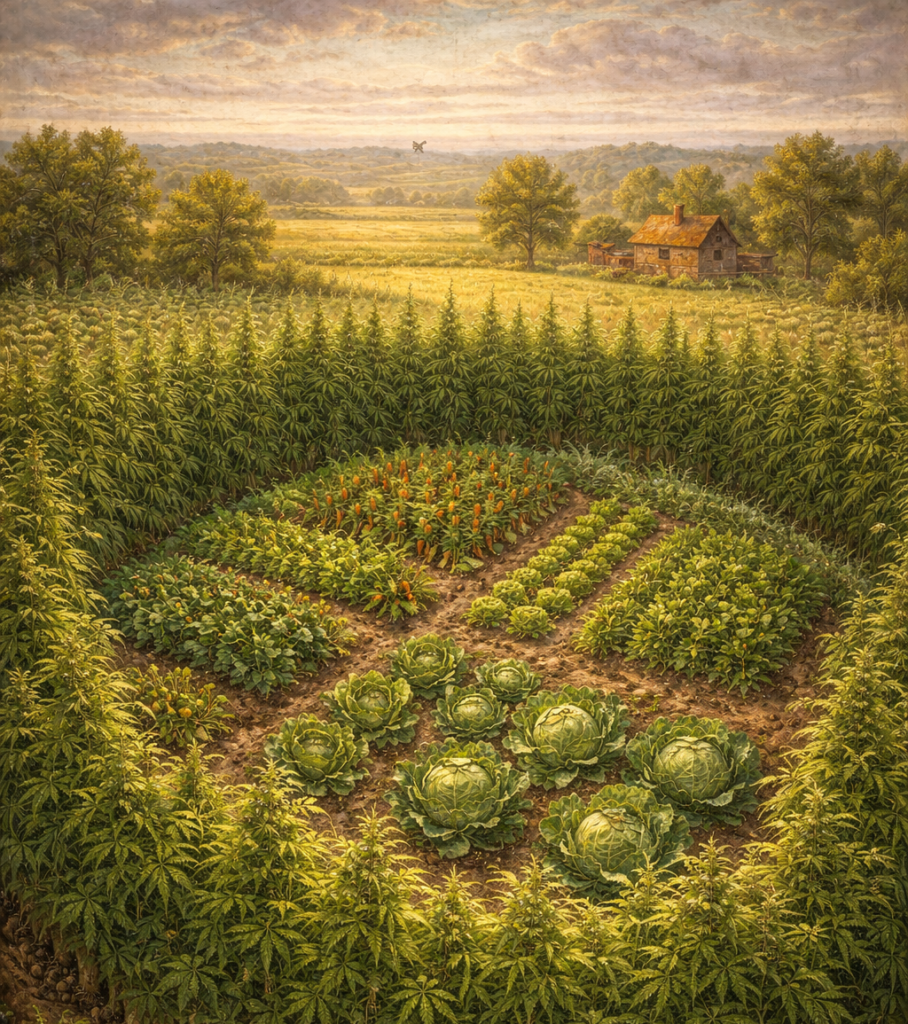


“It is a common practice in many parts of the Continent to sow a belt of hemp round their gardens, or any particular spot where they wish to preserve their crops from the mischievous attacks of flies or caterpillars. We would wish this experiment to be frequently made in turnip fields; for, should it succeed in protecting those crops from the ravages of flies, as well as the cabbages from the caterpillar, it would accomplish a most desirable end.”


Such practices illustrate how hemp functioned not simply as a crop but as a tool of environmental management within the traditional farm. Hemp cultivation was woven into the seasonal rhythms of peasant farming, where each stage of planting, harvesting, and rotation was carefully considered. The plant protected crops, supported livestock, and helped maintain the fertility of the soil itself. In this sense, hemp functioned as a cornerstone of perennial land management.

This integrated system was well understood by contemporary agricultural authorities. In 1790 the pamphlet The Mode of Cultivating and Dressing Hemp, written by Abbé Brulles and printed by order of the Lords of the Committee of Council for Trade and Foreign Plantations—the body responsible for overseeing British trade and colonial commerce—outlined how hemp could be cultivated as part of a self-sustaining agricultural cycle. Farmers were advised, for example, to scatter turnip seed among the standing male hemp plants. After the hemp was harvested, the turnips would continue growing, providing valuable fodder for sheep or cattle.

As the animals grazed, they naturally manured the ground, returning nutrients to the soil and preparing the field for the next year’s planting. Through this simple yet effective practice, hemp cultivation became closely tied to livestock feeding, crop rotation, and soil renewal. The field that produced hemp one season could, through the careful integration of animals and companion crops, be restored and made ready to bear hemp again the next.
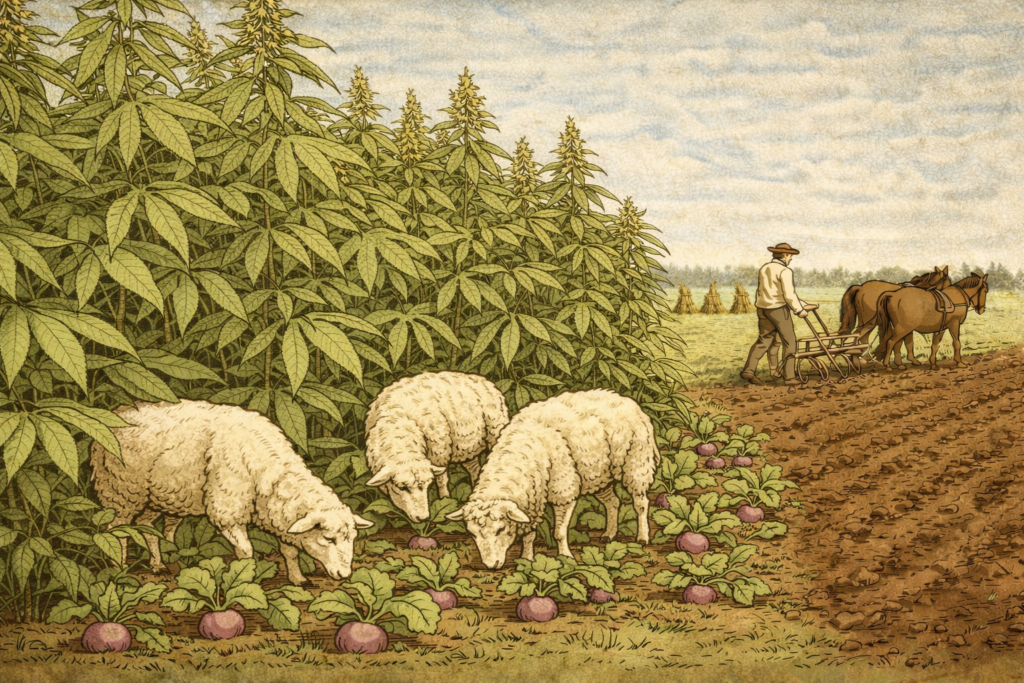
 

In France it is common, at the time of pulling the [Male] Hemp (pollen producing), to scatter turnip seeds in among the stems of the [Female] Hemp (Seed & Floral Producing), which are left standing, and these turnips frequently produce a good deal of feed for sheep or cattle after the Male Hemp is taken off. It is obvious that whatever has this effect, has, besides the benefit of supporting the stock of a farm, that of aiding to manure the Hemp-grounds, especially if it be sheep that are fed on it; therefore if this method fails, it would be prudent, immediately as the Hemp is off the ground, to plow it up, and sow turnips, cole-seed, rye, or any other thing proper for sheep feed, which can be gotten off early in the next spring, so as to be able to till the land well in time for receiving the Hemp seed.


Seen in this light, hemp stood not merely as a source of fiber for rope, sailcloth, and clothmaking, but as a central organizing crop within the traditional farm economy. It linked pest control, crop protection, livestock husbandry, and soil fertility into a single recurring cycle—one that allowed farmers to sustain both their land and their livelihoods from year to year.

Lastly, to destroy “punices,” a pernicious kind of insect—possibly another term for termites—that were known to climb or devour wooden bedposts, it was advised to “Take the Gall of an Ox, and Oil of Hempseed, mix them together, and rub the Joints and Wood of the Bed, and where you have rubbed never any Punice will come.” In addition to its deterrent qualities, the application may also have yielded an unexpected benefit: a brightened wooden sheen left by the hempseed oil itself, another inherent and valued property of the plant.


Above is merely a handful of once-common uses of a plant that touched nearly every sphere of daily life. It wrapped roses, repelled pests, expelled parasites, and stabilized systems that could not afford to fail. In this domestic theater, hemp proved itself not as superstition, but as infrastructure. And like so many of the materials that once underwrote everyday survival, its greatest power lay precisely in how little attention it demanded.

PIERCE REDFERN

Sales & Production

I am native to Richmond and attended Collegiate School and The University of Alabama. I am married to my wife, Lauren, and we have two children together, Palmer and Hendley. Graham is my older brother and I have been with the company since the fall of 2022.

I enjoy hunting, fishing and just about anything outdoors. Graham’s strong passion for this industry motivates others to excel, including myself. I love the team we have together now and can’t wait to see what the future holds for Redfern Hemp Co.!

GLORIA RAMIREZ

Kitchen Production

Gloria is from Guatemala. She moved to Virginia in 2023 and began working with the Redfern Team.

Gloria plays a pivotal role in ensuring that our products are precisely packaged using our quality control SOP guidelines.

ROB UJEVIC

Outside Sales

I’m from Reston, VA currently living in Richmond and Engaged with no kids yet… I began working for Redfern after my original venture, Gourmet Hemp Foods, partnered with them. I love Redfern cause they offer freedom and flexibility to grow.

Redfern is family oriented and serves the community and customers with utmost diligence. Graham Redfern is the hardest working leader I’ve ever had the privilege to work for!

WHITNEY MORGAN

Market Manager

I’m from Caroline County, Virginia and I am married to my husband Ryan. I’ve worked with Redfern Hemp Co. a little over two years. Before that I was a nanny and I worked as a pediatric dental assistant.

I handle online sales and a few outside wholesale accounts. Working with Redfern is a dream job I never thought I’d have.

We are a true family. We work like one, and argue like one. As a team we are flexible and have a real love for the plant and what it can do. There is no limit for the plant so there is no limit for us.

For example, my mom suffered from hair loss after Covid. She started to add Redfrn’s Whole Plant Tincture into her shampoo and conditioner and it helped her hair regrow. The plant is magic!

TIFFANY OBLINSKY

HR & Administration

Tiffany is the anchor of our team, ensuring that we stay organized and that the company’s operations are always running smoothly. During her free time, Tiffany enjoys taking her family to Lake Anna while simultaneously keeping Graham in line from her smartphone!

Corey Reed

Social Media Manager

Hi, I’m Corey. Originally from Charlotte, NC, I’ve called Virginia my second home for over 12 years. With a 10-year background in healthcare and nursing, and 5 years in content creation and social media, I’ve developed a diverse skill set. In my free time, I enjoy creating content, writing music, fishing, and being the best father I can be. Working with Graham and the Redfern team has been a dream come true. It has allowed me to pursue my passions for content creation, health and wellness, community morale, and making meaningful connections. At Redfern Hemp Co, I oversee the social media side of the business. You can also catch me at Redfern Market, so feel free to stop by and say hi!

COURTNEY KUSTERER

Production / Sales / Event Manager

Knowledgeable and passionate about the hemp plant, Courtney is an all around asset to our company. Since her early days with Graham in Waynesboro, she has acquired invaluable insights and business knowledge to help the success of our small business. Her ability to tell the Redfern story is unmatched. If you’ve ever seen one of our event setups, you can tell that Courtney had her creative ideas flowing. She has built a strong wholesale portfolio, while strengthening our network of industry connections. Her expertise in directing customers to the right products is undeniable, playing a pivotal role in assisting Graham in building the company from the ground up. In her free time, Courtney enjoys moments on the farm with Graham and their farm family of cat, cows, chickens, ducks, and dogs. She also values family time at Virginia Tech football games and moments on the boat or at the beach.

GRAHAM REDFERN

Owner & Hemp Farmer

Before I became an American hemp farmer and entrepreneur, I first heard of the hemp industry during a period when my construction business thrived, but the housing crash of 2009 changed everything. While visiting Asheville, North Carolina, I encountered a groundbreaking green building – a house made 90% from hemp, from the flooring to the walls, excluding only electrical components and appliances.

Intrigued, I consulted with Andrea Herman, president of the Hemp Industries of America, spending an hour and $150 to understand the challenges of building such houses in the U.S.. When Andrea explained the steep costs preventing widespread use of U.S.-grown hemp, it ignited a passion in me. I questioned, “Why not?” This moment became a catalyst for my deep dive into the hemp industry.

Passage of the Farm Bills

In 2014, the passing of the Farm Bill allowed universities to grow hemp, prompting me to shift from the car industry. Initially unsure of my path, I invested in penny hemp stocks and connected with the Virginia Industrial Hemp Coalition, working with universities such as JMU, UVA, VSU, and Virginia Tech to explore potential markets.

For four years, restricted by regulations to work with universities, I delved into the banking industry. When the 2019 Farm Bill dismantled barriers, allowing American farmers to cultivate cannabis plants with less than 0.3% THC, my dream took a leap. Redfern Hemp Co. was born, marking the legal sale of hemp products in Virginia for the first time in over seventy years. With my girlfriend Courtney, we hustled – attending state fairs, cultivating hemp on our 42-acre Caroline County farm, and navigating the burgeoning industry. Fast-forward to 2023, and despite being one of the few companies remaining, we face challenges.

Unfortunately, Virginia lawmakers have strained our efforts, declaring federally legal cannabinoid-derived hemp products illegal unless sold by a select few medical marijuana operators.

In the face of Virginia’s attempt to monopolize medical marijuana, we persist in expanding cannabis job opportunities for all Virginians.

We champion Virginians’ rights to affordable, high-quality products, battling against restrictive legislation. It’s disheartening to see the government hindering the benefits of this plant, including job creation and increased taxation.

Restoring Virginia’s Hemp Farming Legacy

There was a time when Virginian hemp farmers paid taxes with hemp. Reintroducing low-dosage, safe cannabinoid products in smoke shops, convenience stores, and local markets could restore this tradition on a broader scale than a handful of licensees. We’re committed to reclaiming this birthright, enabling Virginians to pay their taxes with hemp once again.

Are you over 21?

We need to make sure you are the proper age before entering this website