

FOR DIGESTION
Hemp’s place in early medicine was neither mystical nor marginal. It was practical and grounded in the empirical habits of pre-modern life. Remedies survived because they appeared to work often enough to justify repetition.
One of the hemp seeds most frequently cited benefits concerns disorders of digestion. One passage claims and that a simply “decoction of the said seed Incidentally, eases the pains of the Colic (severe cramping pain in the belly/guts), and allays the troublesome humours in the Bowels.” Another, more concerned with a man’s fertile rigor, claimed that:
The Seed of Hemp used frequently, is good for those which are troubled with a thorn in the flesh, for besides that, it consumeth windiness (gas), it does so much disperse it, that it dryeth up the natural seed of procreation therewith
Natural Paradise the History of Plants, Herbs and Fruits (1657)
FOR WELLNESS
Respiratory ailments formed another major category of use. Chronic coughs, particularly those described as “dry and hot,” were treated with hempseed “being boiled in milk till it cracks.” Hempseed, when prepared with boiled milk or “stamped and taken in white wine,” was highly commended as a remedy for the jaundice (a yellow tinting of the skin) and for complaints of the liver.
In addition to staving off illness, hemp was also enjoyed as a nighttime tonic in the form of a Hempseed posset “with some Nutmeg.” A posset was a traditional drink made from milk curdled with wine or ale, often spiced and used as a remedy for minor ailments, or to “procure sleep being taken bedward.” Hemp grain, and its rich seed oil, was clearly revered for its perceived immune-fortifying attributes.
FOR INFLAMMATION
Hemp assisted, in ways sometimes unexpected, in the fight against pain and inflammation. For pleurisy, an inflammation of the lining of the lungs that made breathing unbearable, hemp played a less glamorous but essential role as a bandage in a treatment intended to draw heat away from the chest.
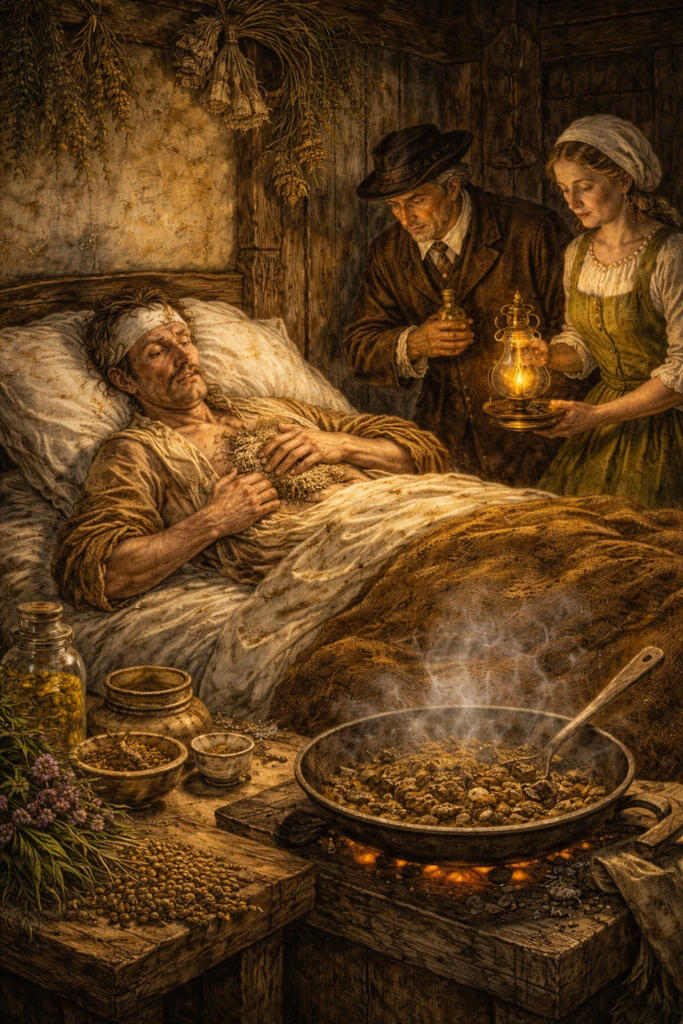
“Take Cow-Dung just hot from the Cow,” the instructions begin, and “put it in a Pan, and Fry’em together so that they do not burn; then take a Hempen Cloth and make a plaister, which bind about the Side that is pained as hot as can be endured.”
For more general cases of inflammation, such as headaches, gout, swellings in the joints, pains in the sinews and hips, and the stiffness associated with age and labor, a decoction of the roots, or the herb itself distilled in water, was recommended to be taken internally. For inflammation caused by burns, hemp’s “fresh juice mixed with a little Oil and butter” was advised as a topical application.
FOR BEAUTIFICATION
The Secrets of Alexis of Piemont presents beauty as a regimen, one that required careful preparation and remained sensitive to the mystic laws of nature. Hair, that eloquent marker of vitality, symbolized the interaction of beauty, wellness, and other-worldliness. It was believed that each individual’s mane responded to the rhythms of the moon and to the quiet power of hemp.
Take the Tops of Hemp when it begins to appear above-ground, steep it Twenty-four Hours in Water, wherewith you shall moisten the Teeth of the Comb you make use of only every increase of the Moon; it is certain this makes the Hair grow much.
If one could not wait for the next moon cycle, Alexis divulges “Another way,” advising that the “Roots of Marshmallows, Hemp, and Psillium-feed” be boiled long together, and that the resulting decoction be used to wash the hair. In the history of shampoo products, this simple preparation stands as a clear forerunner.
A more elaborate solution “to beautify the body,” reads like a lesson in human alchemy. The solution is a carefully prepared bath and The carefully measured ingredients are substantial: Four pounds of blanched sweet almonds, one pound of pure apple kernels, four handfuls of hempseed, one ounce each of marshmallow root and lily seed, and one and a half pounds of elecampane root. All of these are cut and beaten very small, then divided into three or four cloth bags, with one handful of bran added to each bag. From there, the bath is prepared for a steeping at a length that justifies its meticulous preparation, allowing the bath’s combined oils, mucilages, and aromatics to fully impart their effect.
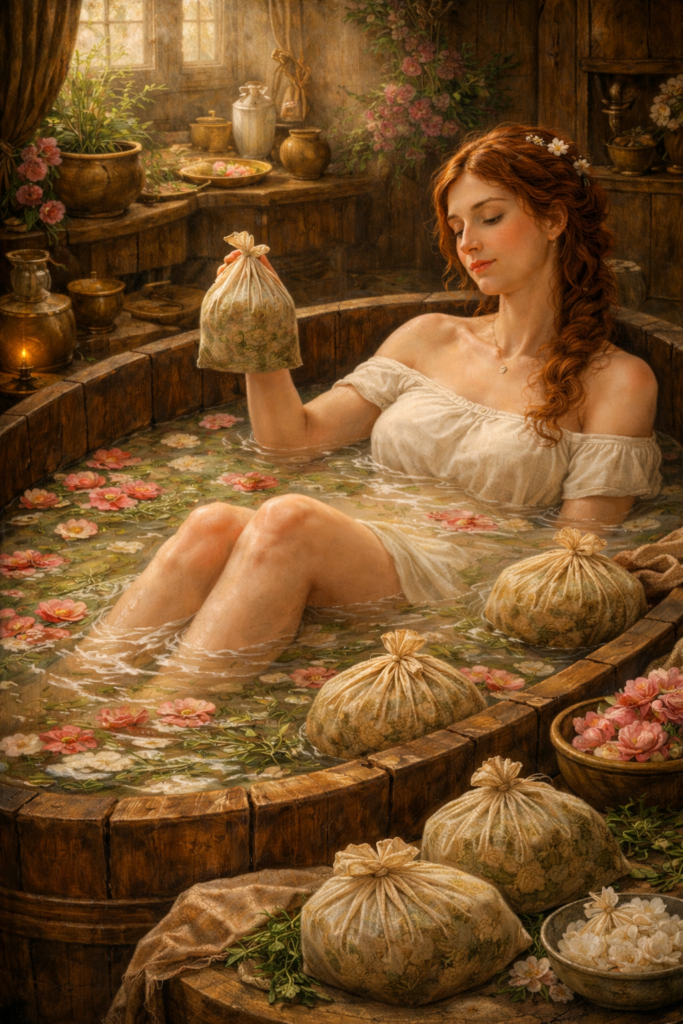
Having well prepared the water for the Bath, it being taken near the wheel of some Mill, take some to boil the Bags in, then fit (one bag) down in the Bath-tub, and with the others rub your Body. You may put into your Bath a Pound of Roses, or Sweet Waters, or Oil of Spikenard about Two Ounces, or Musk, Amber, Civet, Benjamin, Storax, or Orange-Flowers: You must stay in the Bath Three Hours.
CONCLUSION
As an immune fortifier, a combatant against inflammation, and a proven enhancer of beauty, hemp earned its place in the pantheon of botanical mainstays throughout the ages. The foundations of health, like the foundations of trade and state power, were not built on treatise and decrees, but on reliable, readily available natural resources. In an era when survival depended on material knowledge, the line between comfort and catastrophe was often no thicker than a hempen cloth, or no smaller than a single hempseed.
.