
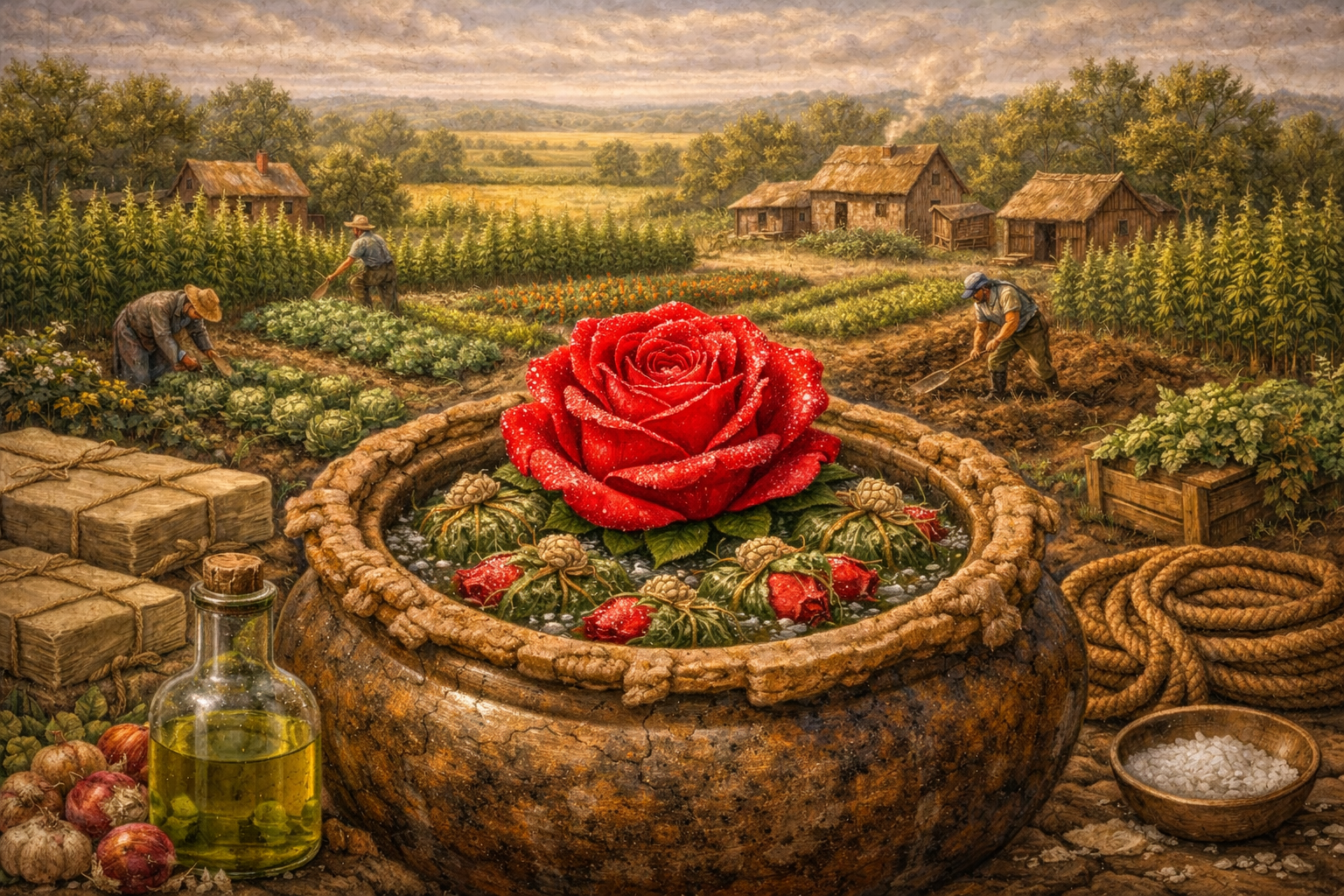
The early household lived in close contact with nature. The Secrets of Alexis of Piemont treats the home and garden as sites of experimentation, where agriculture, domestic management, and natural philosophy were in constant negotiation. Knowledge was passed down not only through books, but often through oral tradition, inherited like any other household tool. Hemp, valued for its reliability, became a practical instrument in every homestead. What worked mattered more than why it worked. The practice of preserving a rose’s vivid red beauty through the winter months is a perfect example of that kind of lived, pragmatic “magic.”
Gather the roses before they open, when they are just ready to break. They must be red Provence roses. Leave the stalks long enough, and wrap them in vine leaves or in hemp, in small parcels, placing twelve roses in each. Powder them with white salt and place them in an earthen pot, salting them as you would purslane. Then fill the pot with verjuice, a highly acidic juice, and seal it by laying clay around the lid so that no air may enter.
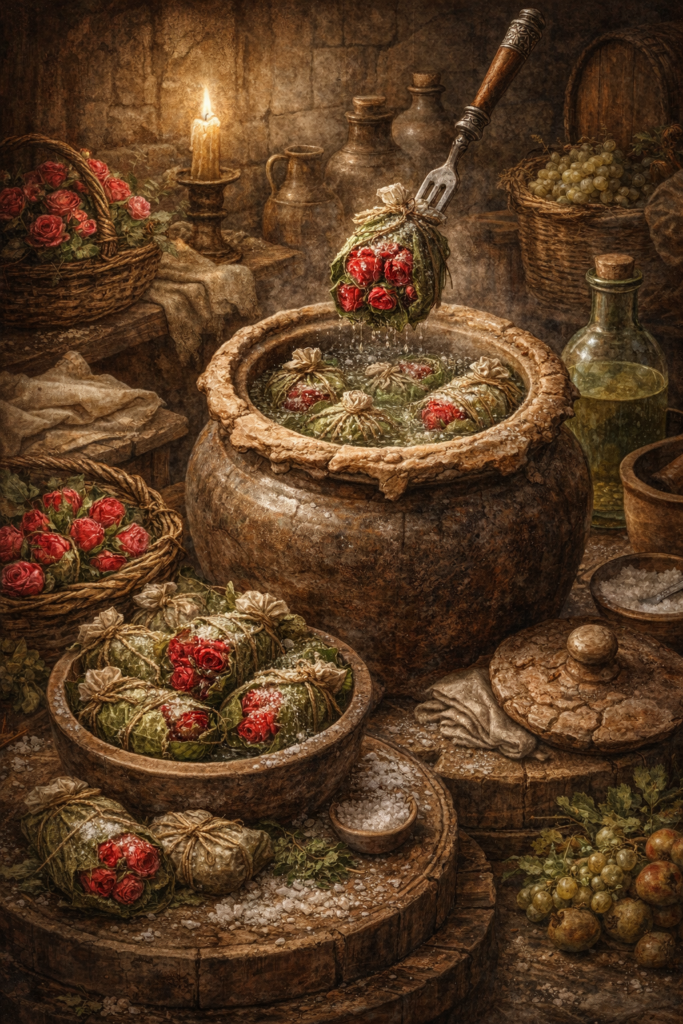
At Christmas, or at any other time when you wish to take them out, you must do so with a silver or wooden fork, and then cover the pot again immediately, for fear they take air. The liquor within the pot is very good for dressing meat, and the roses are as pleasing to the taste as they are to the eye, and will keep open for six weeks.
The way to open them is to make some water lukewarm and leave the roses in it for two full hours, after which they will open simply by blowing upon them. Observe that the pot must be kept at the bottom of the cellar.
In addition to preserving a flower’s color, hemp was also used to preserve the well-being of livestock. The juice of its leaves, when mixed with water was claimed to “be very effectual to kill worms either in Man or Beast.” Extending its reach beyond the bowels, this same hemp juice, “being dropped into the eares, it killeth the worms that are in them, and draweth forth Eare-wigs, or other living creatures gotten into them.”
Beyond husbandry, hemp also served as a remedy for pests, not only in the field but within the household as well. To drive moles from the soil, Alexis advises making “a bundle of Green Hemp,” burying it “Two or Three Foot Deep,” and allowing it to rot. The stench, it was claimed, ensured that “all the Moles will either die, or run away.” Yet rotting hemp was not the only deterrent. It was also common practice to plant a border crop of hemp around a vegetable patch, forming a kind of green barrier that, through observable experience, was believed to protect crops from unwelcome infestations.
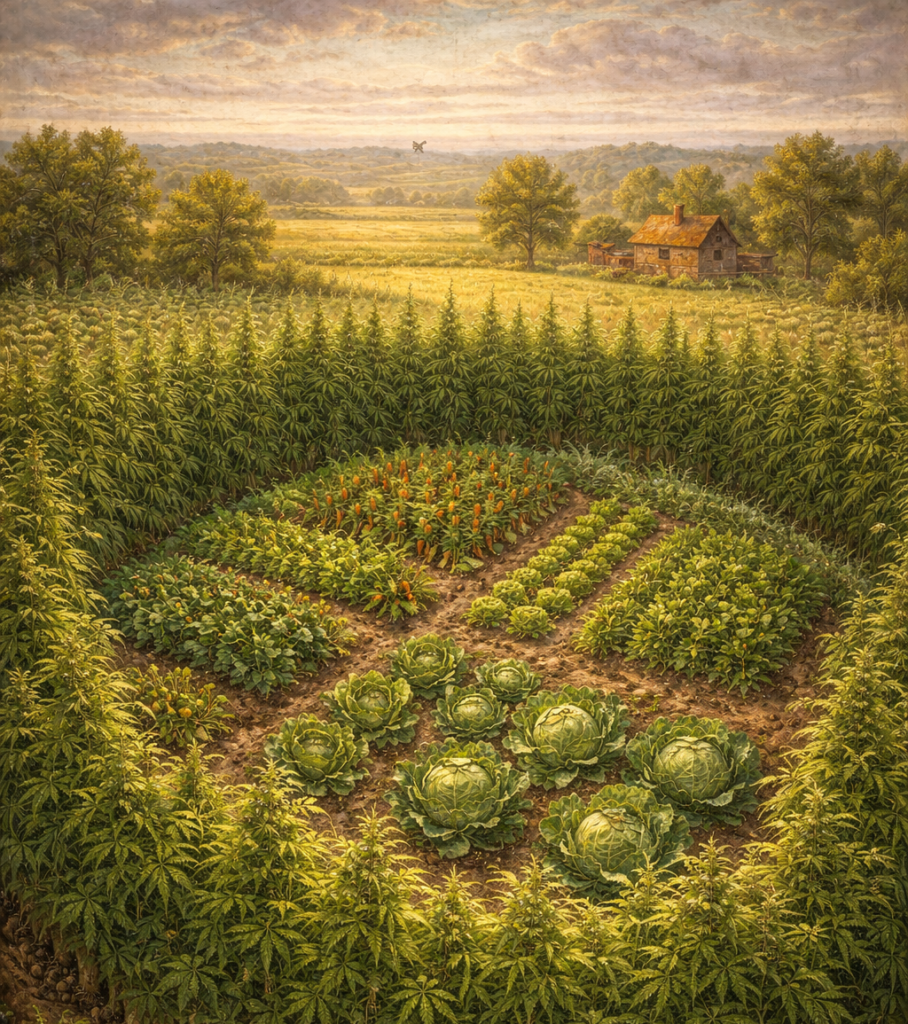
“It is a common practice in many parts of the Continent to sow a belt of hemp round their gardens, or any particular spot where they wish to preserve their crops from the mischievous attacks of flies or caterpillars. We would wish this experiment to be frequently made in turnip fields; for, should it succeed in protecting those crops from the ravages of flies, as well as the cabbages from the caterpillar, it would accomplish a most desirable end.”
Such practices illustrate how hemp functioned not simply as a crop but as a tool of environmental management within the traditional farm. Hemp cultivation was woven into the seasonal rhythms of peasant farming, where each stage of planting, harvesting, and rotation was carefully considered. The plant protected crops, supported livestock, and helped maintain the fertility of the soil itself. In this sense, hemp functioned as a cornerstone of perennial land management.
This integrated system was well understood by contemporary agricultural authorities. In 1790 the pamphlet The Mode of Cultivating and Dressing Hemp, written by Abbé Brulles and printed by order of the Lords of the Committee of Council for Trade and Foreign Plantations—the body responsible for overseeing British trade and colonial commerce—outlined how hemp could be cultivated as part of a self-sustaining agricultural cycle. Farmers were advised, for example, to scatter turnip seed among the standing male hemp plants. After the hemp was harvested, the turnips would continue growing, providing valuable fodder for sheep or cattle.
As the animals grazed, they naturally manured the ground, returning nutrients to the soil and preparing the field for the next year’s planting. Through this simple yet effective practice, hemp cultivation became closely tied to livestock feeding, crop rotation, and soil renewal. The field that produced hemp one season could, through the careful integration of animals and companion crops, be restored and made ready to bear hemp again the next.
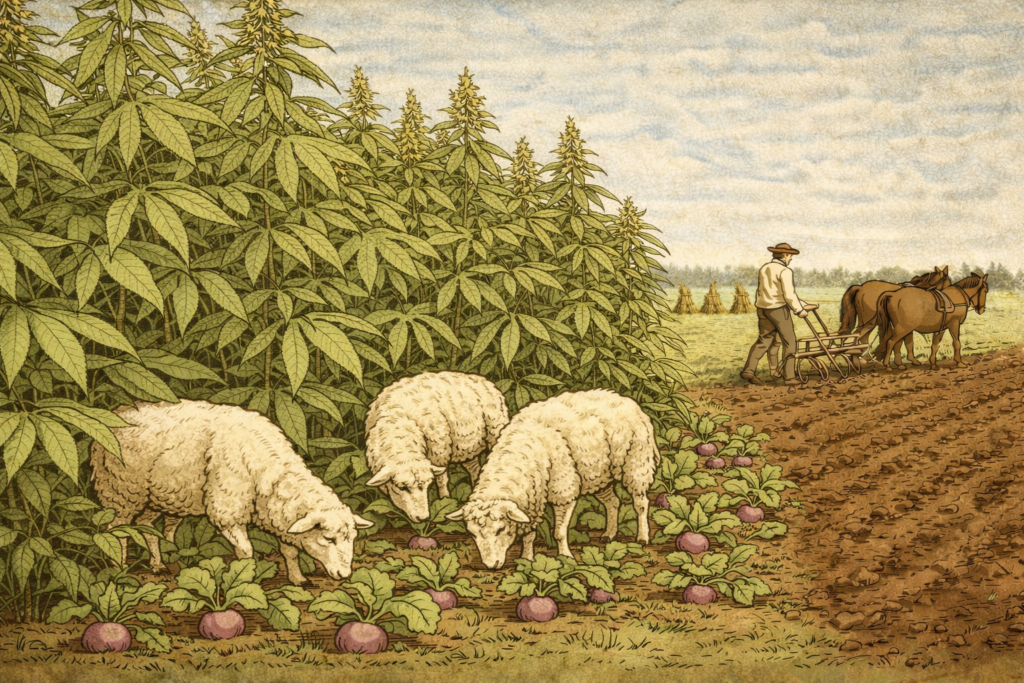
In France it is common, at the time of pulling the [Male] Hemp (pollen producing), to scatter turnip seeds in among the stems of the [Female] Hemp (Seed & Floral Producing), which are left standing, and these turnips frequently produce a good deal of feed for sheep or cattle after the Male Hemp is taken off. It is obvious that whatever has this effect, has, besides the benefit of supporting the stock of a farm, that of aiding to manure the Hemp-grounds, especially if it be sheep that are fed on it; therefore if this method fails, it would be prudent, immediately as the Hemp is off the ground, to plow it up, and sow turnips, cole-seed, rye, or any other thing proper for sheep feed, which can be gotten off early in the next spring, so as to be able to till the land well in time for receiving the Hemp seed.
Seen in this light, hemp stood not merely as a source of fiber for rope, sailcloth, and clothmaking, but as a central organizing crop within the traditional farm economy. It linked pest control, crop protection, livestock husbandry, and soil fertility into a single recurring cycle—one that allowed farmers to sustain both their land and their livelihoods from year to year.
Lastly, to destroy “punices,” a pernicious kind of insect—possibly another term for termites—that were known to climb or devour wooden bedposts, it was advised to “Take the Gall of an Ox, and Oil of Hempseed, mix them together, and rub the Joints and Wood of the Bed, and where you have rubbed never any Punice will come.” In addition to its deterrent qualities, the application may also have yielded an unexpected benefit: a brightened wooden sheen left by the hempseed oil itself, another inherent and valued property of the plant.
Above is merely a handful of once-common uses of a plant that touched nearly every sphere of daily life. It wrapped roses, repelled pests, expelled parasites, and stabilized systems that could not afford to fail. In this domestic theater, hemp proved itself not as superstition, but as infrastructure. And like so many of the materials that once underwrote everyday survival, its greatest power lay precisely in how little attention it demanded.