
The cardinal commonwealth has made significant strides in advancing Virginia cannabis laws, transitioning from a prohibitionist stance to a more permissive approach. The state has legalized both medical marijuana and hemp, offering a range of potential benefits. However, these changes have also brought forth new challenges and considerations. In this article, we will delve into the pros and cons of Virginia’s cannabis laws, comparing the distinctions between medical marijuana and legal hemp products, and examining the potential impact on individuals, communities, and the state as a whole.
Medical Marijuana Dispensary Laws:
- Purpose: To provide medical marijuana to patients with qualifying conditions.
- Eligibility: Patients must have a qualifying medical condition, as certified by a licensed physician.
- Purchase Restrictions: Patients must obtain a medical marijuana card from the Virginia Board of Pharmacy.
- Product Types: Dispensaries sell a variety of medical marijuana products, including flower, oils, edibles, and concentrates.
- Pricing: Prices for medical marijuana products can be high, especially for patients who do not have insurance coverage.
- Regulation: The Virginia Board of Pharmacy regulates medical marijuana dispensaries, including licensing, product safety, and patient privacy.
Pros for Virginia Customers:
- Provides access to a potential treatment option for qualifying medical conditions.
- Can be a more controlled and regulated alternative to the black market.
- May have potential therapeutic benefits for certain conditions.
Cons for Virginia Customers:
High prices can be a significant barrier to access for many patients, especially those who are on fixed incomes or who have limited insurance coverage. The cost of medical marijuana can be particularly burdensome for patients who need to purchase the medication on a regular basis. In addition to the direct cost of the medication, patients may also need to pay for doctor’s visits, medical marijuana cards, and travel expenses to reach a dispensary. These additional costs can make it difficult for some patients to afford medical marijuana, even if they believe that it would be beneficial for their health.
The application process for a medical marijuana card can be time-consuming and expensive. Patients must first obtain a recommendation from a licensed physician, which can require multiple doctor’s visits and fees. Once they have a recommendation, patients must then submit an application to the Virginia Board of Pharmacy. The application process can take several weeks or even months to complete, and patients may need to submit additional documentation or information during the review process. This can be frustrating and stressful for patients who are eager to access medical marijuana.
Limited availability of dispensaries, especially in rural areas, can also be a barrier to access for many patients. While the number of medical marijuana dispensaries in Virginia has been increasing in recent years, there are still many areas of the state that do not have a dispensary. This can make it difficult for patients who live in rural areas to access medical marijuana, especially if they do not have access to transportation. Additionally, the limited number of dispensaries can lead to long wait times and limited product selection.
Retail Hemp Laws:
- Purpose: To regulate the sale of hemp-derived products, including CBD, CBG, CBN, CBDV.
- Eligibility: No specific eligibility requirements, like a medical condition, are needed to purchase hemp products.
- Purchase Restrictions: You must be 21 years of age to purchase hemp products in Virginia.
- Product Types: Retail stores sell a wide variety of hemp products, including CBD oil, gummies, topicals, and beauty products.
- Pricing: Prices for hemp products vary widely, but they are generally more affordable than medical marijuana products.
- Regulation: The Virginia Department of Agriculture and Consumer Services regulates the sale of hemp products, including labeling requirements and safety standards.
Pros for Virginia Customers:
- More affordable than medical marijuana: Hemp products are generally more affordable than medical marijuana products, making them a more accessible option for many consumers. This is because hemp products are not subject to the same regulatory requirements as medical marijuana, which can drive up costs. Additionally, hemp products are often sold in larger quantities, which can also help to reduce the cost per unit.
- Wider range of products available: Retail stores offer a much wider range of hemp products than medical marijuana dispensaries. This is because hemp products can be used for a variety of purposes, including relaxation, pain relief, and beauty. Medical marijuana, on the other hand, is primarily used for treating medical conditions.
- No need for a medical marijuana card: To purchase hemp products, you do not need to obtain a medical marijuana card from the Virginia Board of Pharmacy. This makes hemp products more accessible to a wider range of consumers, including those who do not have a qualifying medical condition.
- Can be purchased at various retail locations: Hemp products are available at a variety of retail locations, including grocery stores, pharmacies, and specialty shops. This makes it easy for consumers to find and purchase hemp products, regardless of where they live.
- Can be used for a variety of purposes: Hemp products can be used for a variety of purposes, including relaxation, pain relief, and beauty. This makes hemp products a versatile option for consumers who are looking for natural and effective products.
Cons for Virginia Customers:
- May not be as effective as medical marijuana for certain conditions.
- Quality and potency can vary widely among products.
- Some products may contain trace amounts of THC, which could be a concern for individuals who are drug-tested.

Why Virginians Choose Redfern’s High Quality Products
The ‘cons’ associated with Virginia’s Hemp Industry pose difficulties for both customers and local vendors alike. Especially Local Vendors like ourselves who’ve jumped through every legal hoop to remain compliant and in good standing with the State. Many hemp upstarts are simply attempting to make a quick buck with little regard to producing a quality and effective products. Many products they’re attempting to are are simply illegal. In other words, their customers are an after thought.
This is not so with the Redfern Hemp Company. Graham Redfern, the founder, goes above and beyond to not only ensure his customers are getting exactly what they pay for, but he, also, wants to ensure that the competition is doing the very same thing! The Industry wins when its looking out for each-other; because, in reality, one bad actor can make the rest of look really bad.
But this is exactly the reason Redfern Customers are extremely loyal. They know we care. They know anyone on the Redfern Team will go out of their way to make any problem right. But maybe more important than our excellent customer service, is that our hemp products actually work. Try any of Redfern’s edibles, tinctures and topicals for yourself and experience what the true benefits of the hemp plant truly should be.
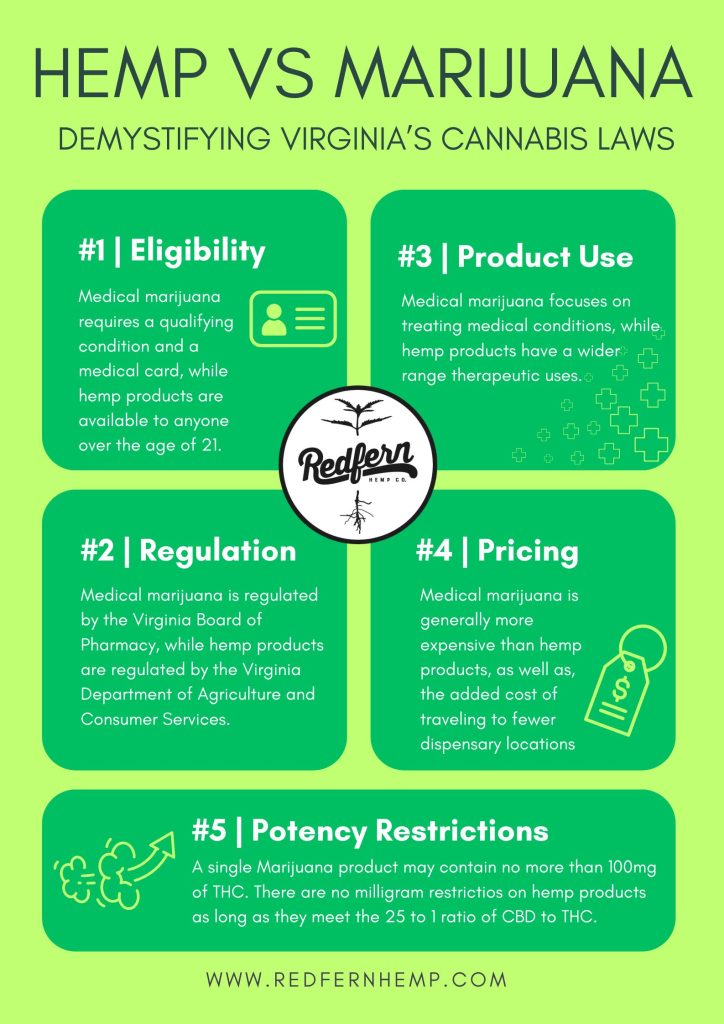
Quick Re-Cap | The Key Differences Between Virginia Cannabis Laws:
- Eligibility: Medical marijuana requires a qualifying condition and a medical card, while hemp products are available to everyone.
- Product Focus: Medical marijuana focuses on treating medical conditions, while hemp products have a wider range of uses.
- Regulation: Medical marijuana is regulated by the Virginia Board of Pharmacy, while hemp products are regulated by the Virginia Department of Agriculture and Consumer Services.
- Pricing: Medical marijuana is generally more expensive than hemp products.