
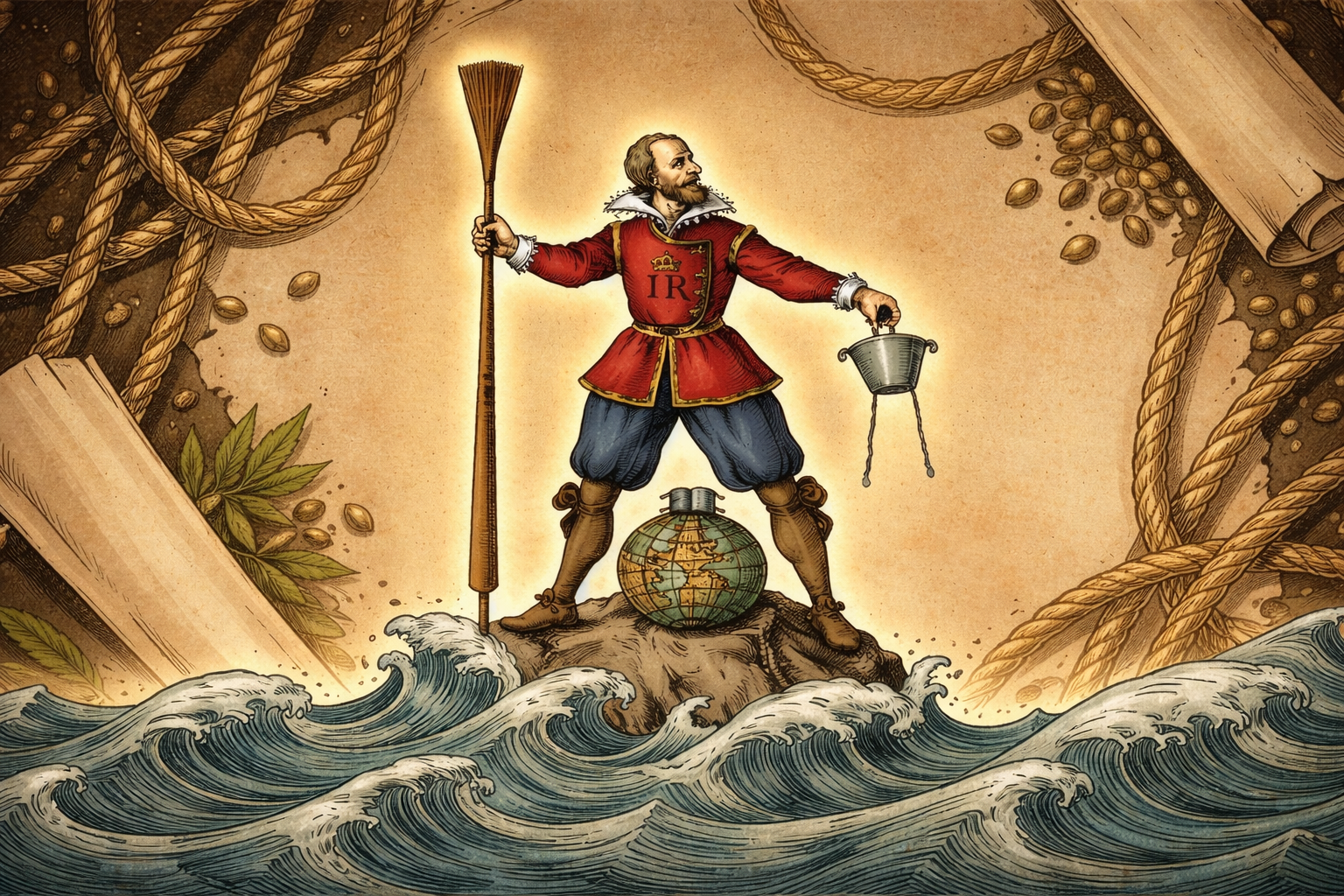
There are natural resources in history so ubiquitous that they become nearly invisible. They are so fundamental to the construction of daily life that they vanish into it, like mortar between stones. Salt. Iron. Linen. And hemp. Hemp was not merely a crop so much as a condition of life, so common as to be overlooked, and yet so essential that, without it, the machinery of pre-mechanical society would have seized.
One 17th century poet, John Taylor, understood this with a kind of delirious clarity. In Praise of the Hemp Seed (1630), he elevates this seemingly innocuous grain as the keystone to the economy (as he understood it). His voice is half comic, half prophetic, as though he can hardly believe the magnitude of what he is describing:
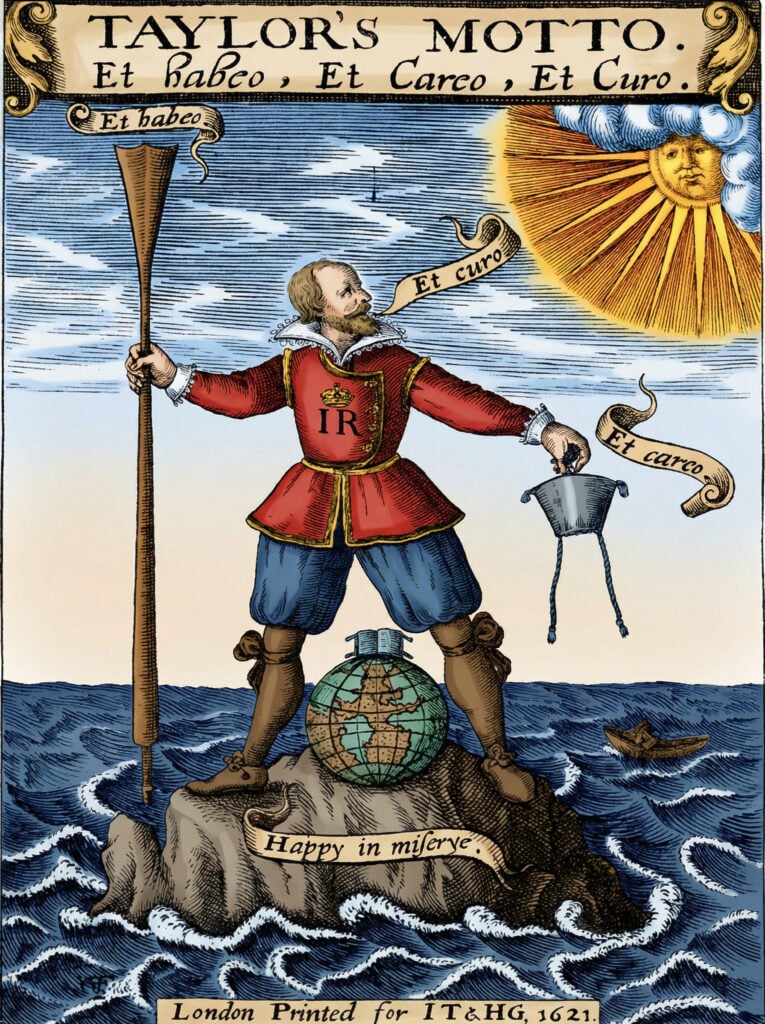
“I have here, from a grain of hempseed, made a mountain greater than the Apennines or Caucasus… Here is labour, profit, clothing, pleasure, food, navigation: divinity, poetry, the liberal arts, arms, virtue’s defence, vice’s offence, a true man’s protection, a thief’s execution.”
Taylor, an oarsman by trade and a satirical poet whose work miraculously survived the centuries, earned the fitting moniker “the Water Poet.” For this obscure figure in literary history, hemp was both liberator and, less hospitably, executioner. This multipurpose plant was the organic ether that bound society together through clothing, nourishment, cordage, and paper.
All this and more is paper, and all this,
From fruitful hempseed still produced is.
Were’t not for rags of this admired lint,
Dead were the admirable art of print.
Nor could the printers, with their forms and proofs,
Work for their own and other men’s behoofs.
Octavo, quarto, folio, or sixteen:
Twelves, nor yet sixty-four had e’er been seen,
Nor could their pages be the means to feed
And clothe them and their families at need.
Hemp’s by-products permeated every nook and cranny of human life. The following passage, again, reiterates the life cycle of a commodity, that in every stop on its trip, retained its prestige as indispensable for some aspects of daily life.
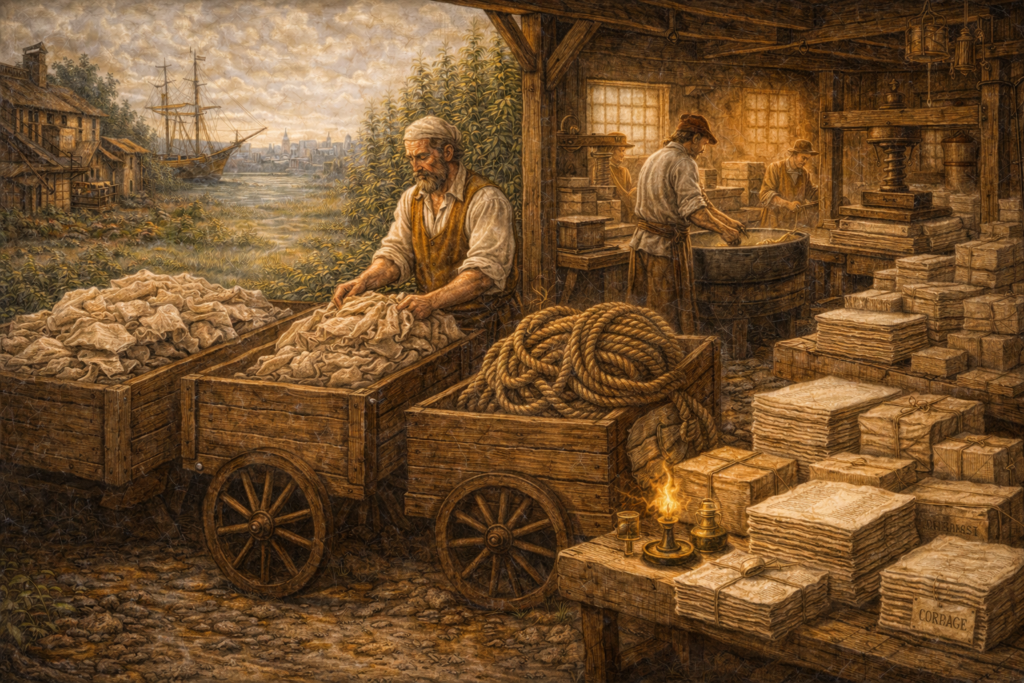
“It is a duty incumbent on society, not to allow hempen rags, or even old ropes, to be destroyed. They are carefully sorted by the paper-maker, the finest being reserved for the purposes of literature and correspondence, while inferior sorts are selected for the various purposes of packages and paperhangings.” (Phillips, 1821, p. 231)
The poet lived in a society acutely aware of the power of the printing press – still a relatively new innovation. From the Gutenberg Bible (1455) to Tyndale’s Protestant translation, which proliferated throughout England in the sixteenth century, the medium that carried transcendence and transformed public life was not to be taken for granted. For Taylor, the seed that sustained thought and commerce should be protected and patronized by the foremost powers of the realm. It was clearly in their best interest.
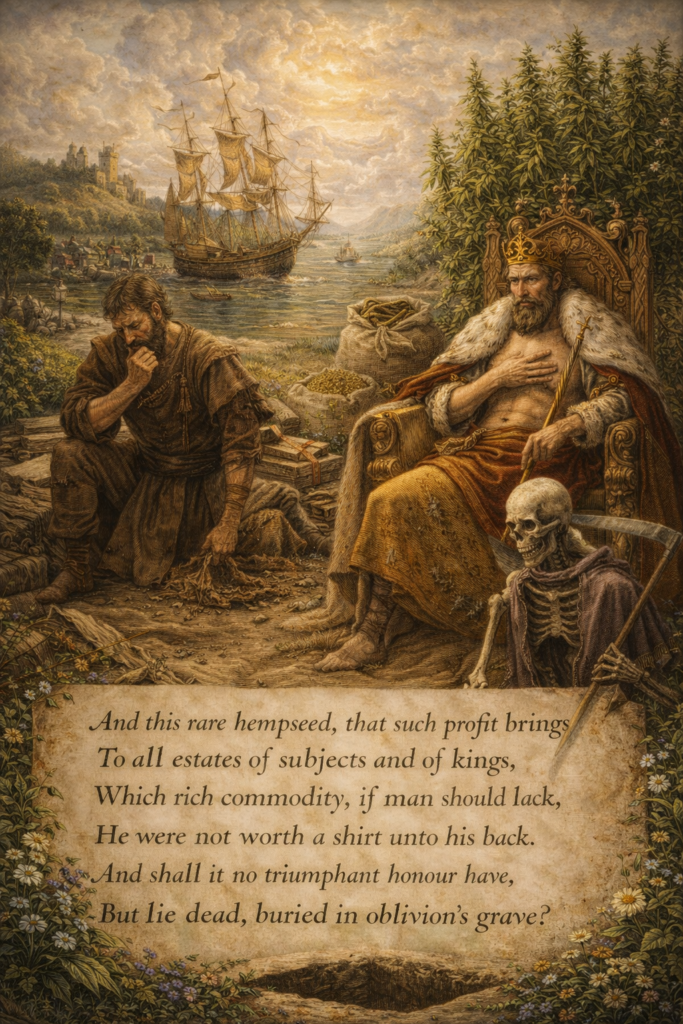
The utilitarian empire of hemp expanded beyond maritime and its latter intellectual uses. It lived in kitchens, medicine cabinets, and even armories. Hemp was threaded through domestic routine and national ambition alike.
One book of oddities, New Curiosities in Art and Nature, or, A Collection of the Most Valuable Secrets in All Arts and Sciences, translated from French in 1720, exclaimed to reveal what had long been “lock’d up in the Closets of the Best Families of Europe.” The ecstatic author assured his readers that here were: “Receipts highly esteemed by the most Learned Physicians, Elaborate Chemists, and Curious Virtuosos.” Lastly, he openly invites the “People of the Best Rank,” as well as, the “Housekeepers, Tradesmen, Artificers” to explore the effectiveness of remedies, oils, essences, and balsams. Among this encyclopedic of coveted concoctions contained novel applications for hempfeed, fabric and its raw feedstock.
In addition to the ‘New Curiosities in Art and Nature,’ two more books of antiquity, also, showcase the pragmatic uses of this universal crop. First is the 18th century book, Adam in Eden or Natural Paradise the History of Plants, Herbs and Fruits (1657).
Since literacy wasn’t a layman’s pastime, but a mark of high birth or priesthood, the author knew whom he was addressing. In a world where the lines of nascent sciences, black arts and homespun remedies all shared a dubious space of credibility—this early evangelist of botany went out of his way to align his findings judiciously with courtly rhetoric:
… to make thee truly sensible of that happiness which Mankind lost by the Fall of Adam, is to render thee an exact Botanick, by the knowledge of so incomparable a Science as the Art of Simpling, to re-inflate thee into another Eden, or, a Garden of Paradise: For if We rightly consider the Addresses of this Divine Contemplation of Herbs and Plants, with that alluring Steps and Paces the Study of them directs Us to an admiration of the Supreme Wisdom, we cannot but even from these inferior things arrive somewhat near unto a heavenly Contentment, a contentment indeed next to that Blessedness of Fruition, which is only in the other World; for all our Pleasures here having but the fading Aids of sense are beholding, or rather subjected to our Humane frailities, so that they must in respect of Expectations in some kind of other ever fall short.
To conclude, I dedicate these my Labours to the Commonwealth of Learning, to the College of Physicians, Surgeons & Apothecaries; to the Court, to the Nobility & Gentry,; In fine to all those that honour this Art, and delight in the peace and Welfare of their Country: entreating them to pass over those failings and aberrations which must needs be incident, to one that has traversed so many Gardens, Woods, Fields, and Hill. With my Prayers for the prosperity of the Nations, together with my best desires for the good success of mine, Endeavors, I take Leave and rest.